First assess your yard’s gradient and soil type, then grade the slope to a maximum 2% drainage and install perforated pipes on a gravel bed to divert runoff. Plant deep-rooted grasses like tall fescue or switchgrass, and native groundcovers such as sedges, spacing them about one plant per square foot and orienting rows perpendicular to the slope. Cover the surface with erosion-control blankets suited to steepness, add a 3-4 inch layer of organic mulch, and build low terraces with proper drainage. Set up drip irrigation with pressure-compensating emitters along contour lines, and periodically mow, aerate, and spot-replant to keep vegetation dense. If you keep these steps in mind, you’ll discover even more detailed strategies ahead.
TLDR
- Grade the slope to a maximum of 2% (≈1:50) and install level steps or terraces spaced 50‑100 ft apart with proper drainage.
- Plant deep‑rooted grasses, native groundcovers, and shrubs (e.g., tall fescue, switchgrass, vetiver, willow) at 1 plant / ft², orienting rows perpendicular to the slope.
- Apply erosion‑control blankets (straw‑coconut for moderate, double‑net jute‑straw‑coconut for steep) and secure with stakes every few feet, then mulch to protect soil.
- Install subsurface drainage (perforated pipe on gravel, French drains, swales) with a 2% slope to divert runoff away from the surface.
- Schedule regular maintenance: light mowing, selective aeration, spot‑replanting, and quarterly inspections for cracks or leaning structures.
Assess Gradient and Soil Type for Effective Slope Stabilization
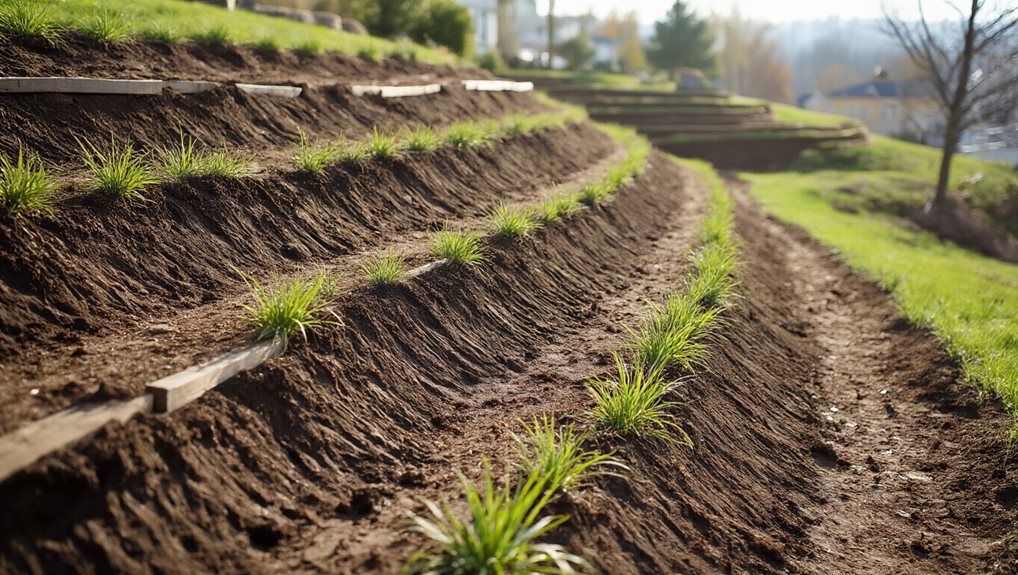
How steep is your yard, and what kind of soil does it hold? You’ll first map the gradient, noting low‑to‑moderate (≤33%), moderate‑to‑steep (33‑50%), or steep (>50%) zones, then match soil type to each slope. Use NDVI and rainfall data to pinpoint erosion hotspots, apply the LS factor formula, and prioritize mulching, drip irrigation, or terraces accordingly. Heavy rainfall is the primary trigger that loosens soil particles and accelerates erosion on steep slopes. Phosphorus deficiency can also affect root growth and soil structure, potentially increasing erosion risk in vulnerable areas link to soil fertility practices.
Select Deep‑Rooted Grasses and Native Groundcovers for Slope Stabilization
You’ll want to choose deep‑rooted grasses like tall fescue or switchgrass because their extensive root systems bind soil particles and reduce landslide risk, while native groundcovers such as sedges and prairie natives add lateral root networks that hold slope and act as living mulch.
Planting them at the recommended density—roughly one plant per square foot for grasses and a tighter spacing for spreading groundcovers—ensures continuous coverage and minimizes erosion gaps.
Remember to orient rows perpendicular to the slope contour, water until the root zone saturates, and apply a 3‑4‑inch mulch layer to help establish the plants quickly.
Deep‑Rooted Grass Selection
What makes a grass truly effective for slope stabilization is its root system, and deep‑rooted species excel because their fibrous roots bind soil particles, increase shear strength, and act like natural geotextiles that reinforce the ground.
Choose vetiver for its unrivaled anchoring, switchgrass for deep penetration, and fescues for adaptability; evaluate root depth, lateral spread, and soil compatibility to ensure lasting cohesion and community confidence.
Native Groundcover Benefits
Why consider native groundcovers alongside deep‑rooted grasses for slope stabilization? Their extensive, lateral root networks bind soil particles, while aggressive spreading via stolons or suckers quickly blankets bare spots, intercepting runoff and forming natural terracing.
Once established they demand little watering or mowing, support wildlife, improve organic matter, and endure drought, shade, or coastal exposure—creating a resilient, low‑maintenance community that safeguards your yard.
Planting Density Guidelines
How many plants per square foot should you place on a sloped yard to prevent erosion while maintaining healthy growth? Aim for roughly 0.05‑0.07 plants per square foot, which translates to 300‑500 trees per acre for hardwoods or 600‑700 for pines, adjusting upward in severely eroding zones. Choose deep‑rooted grasses and native groundcovers, spacing them to match soil moisture, slope gradient, and root‑penetration depth, ensuring stability and a cohesive, resilient landscape.
Install Erosion Control Blankets for Immediate Slope Stabilization
Pick a blanket that matches your slope’s steepness—straw‑coconut blends work for moderate grades, while double‑net jute‑straw‑coconut mats handle the steepest inclines. Secure the mat with stakes or staples placed every few feet, making sure each anchor penetrates the soil to prevent wind or runoff from lifting it. Then sow compatible seed through the fabric and add a thin layer of mulch on top, letting the blanket retain moisture while the seedlings establish a permanent root network. Grid layout supports efficient planning and easy access for ongoing maintenance and monitoring of the slope.
Choose Right Blanket Type
Choosing the right erosion‑control blanket hinges on matching the slope’s steepness to the blanket’s durability and flow‑handling capacity. For 4:1–3:1 slopes, select short‑term straw blankets; 3:1–2:1 slopes benefit from extended‑term straw or coconut blends; 2:1–1.5:1 slopes need long‑term coir blankets.
Use single‑net straw for low slopes up to 3:1 with low flows, double‑net straw for mild slopes up to 2:1 with moderate flows, ensuring tensile strength meets or exceeds the specified minimums.
Secure Proper Anchoring Methods
What keeps an erosion‑control blanket from lifting or tearing under runoff is a solid anchoring system, and you’ll achieve that by preparing the site, digging proper trenches, and fastening the blanket with correctly spaced staples or stakes.
Clear debris, compact soil, then cut 6‑inch trenches at the crest and toe, backfill, and drive 12‑inch‑spaced staples at 45° angles, ensuring edges are staked every two feet and interior every three feet for lasting stability.
Combine With Seed and Mulch
A solid anchoring system keeps the erosion‑control blanket in place, but the next step is to integrate seed and mulch so the slope stabilizes quickly and vegetation takes root.
Sprinkle the chosen seed mix over the fabric, press it into the soil, then spread a thin mulch layer to retain moisture and protect seedlings.
Water lightly, ensuring the blanket stays taut, and check for gaps after rain.
Apply Organic Mulch to Protect Soil and Retain Moisture
Why not start by spreading a thick layer of organic mulch over your sloped yard? The mulch cushions rain impact, slows runoff, and lets water infiltrate gradually, keeping roots moist while preventing erosion. It interlocks with roots, improves soil structure, and feeds microbes as it decomposes, enriching nutrients. This inexpensive, natural blanket also reduces compaction, supports earthworms, and creates a stable, thriving community for your garden. Mulch also helps regulate soil temperature, which benefits pollinator-friendly plants by promoting steady growth and flowering times. Mulch climate protection
Build Terraces or Retaining Walls to Keep Your Slope Stable
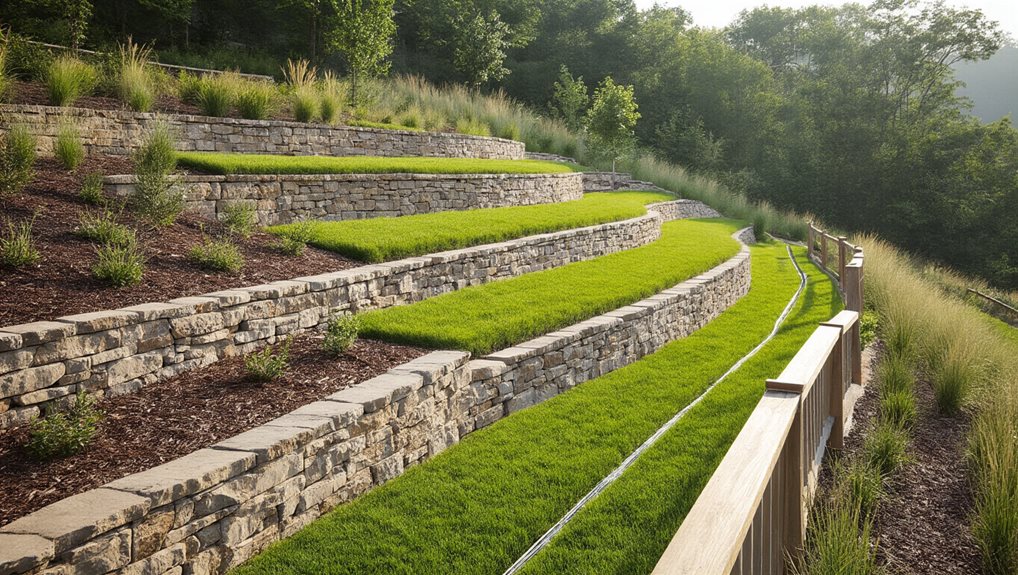
You’ll want to set a gentle 2‑percent slope gradient for each terrace, because that reduces runoff speed and keeps water from pooling behind the wall.
Choose reinforced materials—like stone, concrete block, or pressure‑treated timber—that can withstand soil pressure while still allowing drainage, and incorporate weep holes or perforated pipe to channel excess moisture away.
Finally, plant low‑growing grasses or groundcovers on the terrace surfaces to anchor the soil and complement the engineered stability with natural erosion control. Terrace stabilization
Design Proper Slope Gradient
How can you keep a sloped yard stable while preventing erosion?
Design the gradient so it never exceeds a 2:1 (50%) ratio, because gentler slopes slow runoff, reduce hydrostatic pressure, and allow vegetation to root securely.
Incorporate terraces or retaining walls to break the incline into manageable steps, integrating rocks and plants for added cohesion, drainage, and long‑term stability.
Select Reinforced Wall Materials
Designing a gentle 2:1 slope sets the stage for choosing the right reinforced wall material, because the wall must handle the remaining runoff and soil pressure while fitting the terrain’s aesthetic. You might pick a gravity wall of stone or concrete for moderate slopes, a cantilever design for steeper terrain, segmental interlocking blocks for DIY cost‑effectiveness, geogrid reinforcement for tensile strength, or sheet‑pile systems when space is tight. Each option blends durability with visual harmony.
Integrate Drainage and Planting
Where does water go when a slope isn’t properly managed? You’ll see runoff racing down, eroding soil and destabilizing terraces.
Build level steps spaced 50‑100 ft apart, grade them 2 % perpendicular, and backfill with crushed rock.
Install perforated pipes on a gravel bed, grade drainage at 2 % slope, and plant deep‑rooted grasses, shrubs, and fruit trees to anchor soil and capture moisture.
Create Swales, French Drains, and Dry Wells for Slope Stabilization
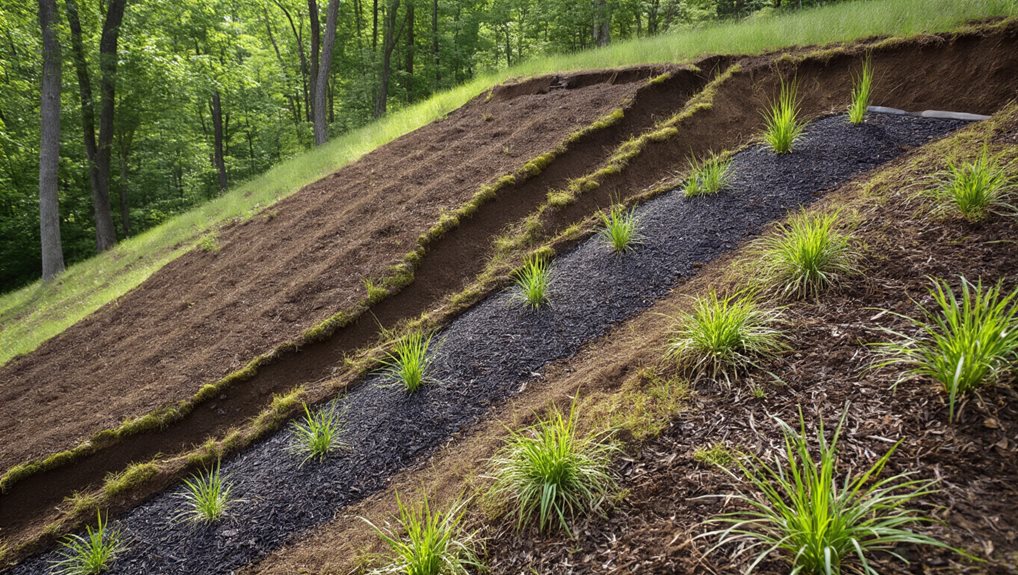
When you integrate swales, French drains, and dry wells into a sloped yard, you create a coordinated system that captures runoff, slows its velocity, and encourages infiltration, thereby reducing erosion and stabilizing the slope.
Design swales with 1‑3 % slopes, trapezoidal cross‑sections, and vegetated turf to achieve 90 % cover; install French drains after soil testing to maintain appropriate water tables and limit flow speed; size dry wells for peak volumes, ensure 6‑inch freeboard, and verify soil permeability for effective subsurface storage.
This unified approach keeps the community garden thriving sustainable drainage.
Set Up Drip Irrigation and Check‑Valve Lines to Minimize Runoff
A well‑planned drip‑irrigation network, paired with check‑valve lines, can dramatically cut runoff on a sloped yard by providing water directly to the root zone while keeping pressure steady across elevation changes.
Install pressure‑compensating emitters along contour lines, bury them a few inches deep, add check valves to stop backflow, and schedule multi‑cycle watering; this guarantees uniform infiltration, minimizes gullies, and strengthens soil cohesion.
Plant Fruit Trees, Berry Bushes, and Herbs to Strengthen Soil
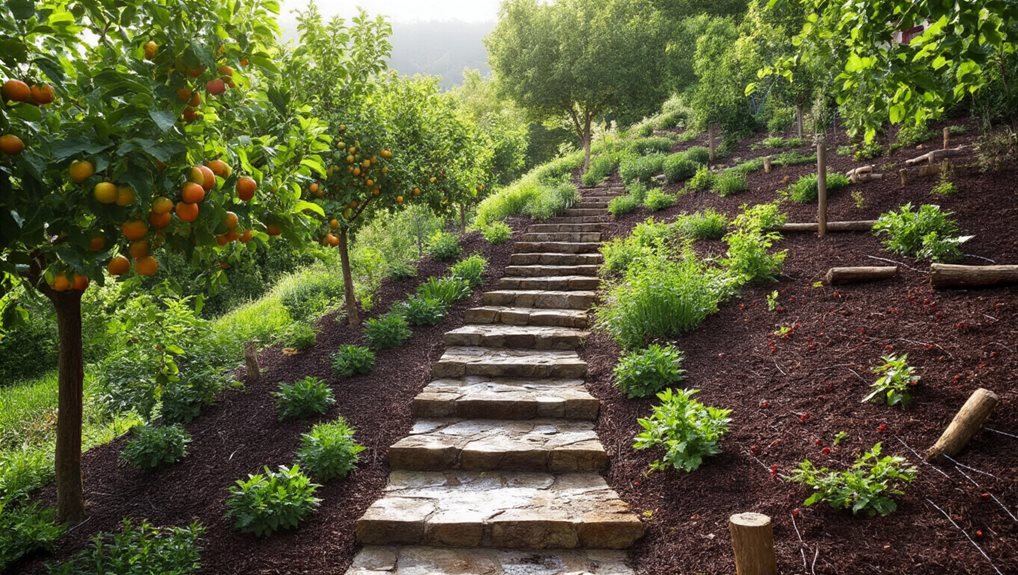
After installing drip irrigation and check‑valve lines to curb runoff, the next step is to add vegetation that physically holds the soil in place. Plant fast‑growing elderberry or willow trees for deep, fibrous roots, intermix with berry bushes like red‑osier dogwood or chokeberry whose dense colonies bind soil, and spread ground‑cover herbs and perennials such as bee balm, daylily, and switchgrass to create a layered, resilient root network that stabilizes slopes and promotes a shared, thriving garden community.
Maintain Slope Vegetation: Mowing, Aeration, and Spot‑Replanting
How can you keep your sloped yard’s vegetation healthy while preventing erosion?
Mow sparingly, using a light blade and cutting at a height that preserves root crowns, then stagger cuts to avoid exposing soil.
Aerate selectively, inserting cores shallowly and mixing compost to improve structure without disturbing established roots.
Spot‑replant dense native groundcovers, dig vertically, create a small bowl for water retention, and mulch lightly to suppress weeds while young plants establish.
Monitor and Repair Structural Elements Regularly for Ongoing Slope Stabilization
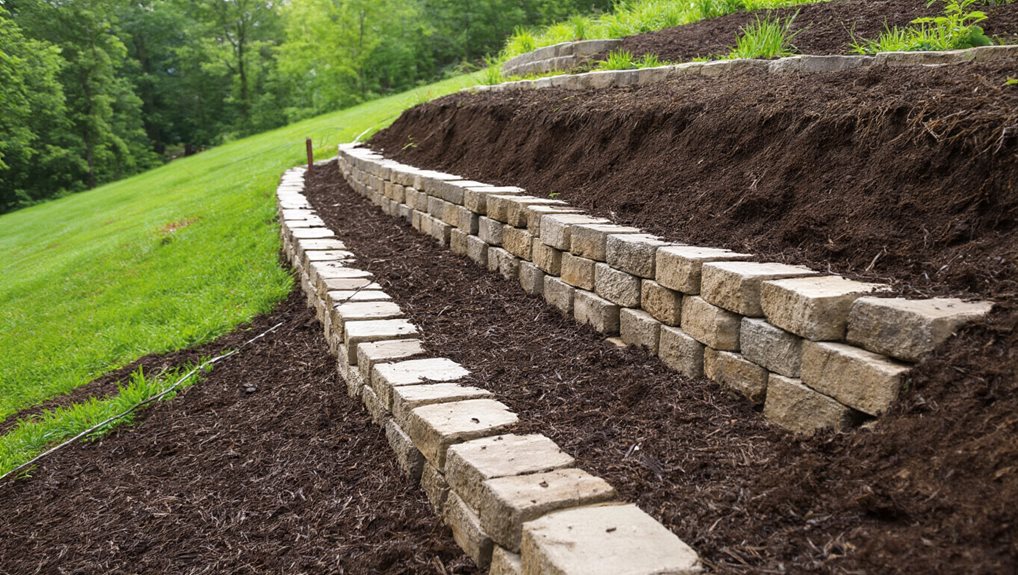
Keeping your sloped yard’s vegetation healthy is only half the battle; the structural components that hold the slope together need the same level of attention. Conduct quarterly visual checks for cracks, bulges, or leaning walls, then repair with grout, epoxy, or rebuilt sections; clean drains, re‑tension anchors, and monitor movement using inclinometers, ensuring every element stays stable and your community feels secure.
Final Note
By evaluating your slope’s gradient and soil type, then combining deep‑rooted grasses, erosion blankets, and organic mulch, you create a resilient vegetative cover that slows runoff and holds the earth in place. Adding terraces, retaining walls, and drip irrigation further stabilizes the terrain while conserving water. Regular maintenance—mowing, aerating, and spot‑replanting—keeps the vegetation healthy, and periodic inspections of structural elements guarantee long‑term slope stability. This integrated approach protects your yard and reduces erosion effectively.

Nathan McPhail is a garden and home DIY expert who writes practical, easy-to-follow advice for homeowners and gardeners. Through Yardique, he shares hands-on tips covering gardening, lawn care, landscaping, home improvement, repairs, tools, and outdoor living. His focus is on helping readers solve everyday household and yard problems with straightforward guidance, useful techniques, and practical solutions.