Water indoor plants by checking soil moisture first—use a finger‑dip or moisture meter—and then adjust frequency to season, plant type, and pot size. In spring water every five to seven days, summer every few days (morning is best), fall weekly, and winter every two weeks for dormant plants. Tropicals need 3‑7‑day intervals with misting, succulents 7‑10 days in heat, ferns every 3‑5 days with daily mist. Measure pot volume (cylindrical ≈ πr²h) to gauge water amount, and keep water lukewarm (65‑72 °F) and chlorine‑free for root health; the next sections will show how to fine‑tune these steps.
TLDR
- Test soil moisture first; water only when the top 1‑2 inches feel dry or a moisture meter reads red (1‑3).
- Adjust frequency by season: spring every 5‑7 days, summer every few days, fall weekly, winter every 2‑3 weeks.
- Tailor to plant type: succulents every 7‑10 days, ferns every 3‑5 days with misting, tropicals every 3‑7 days.
- Use lukewarm (65‑72 °F) water that has sat 24 h to dissipate chlorine and maintain root oxygen.
- Calculate water volume based on pot size (e.g., 5‑inch pot ≈ 1‑2 L) and water until excess drains from the bottom.
Seasonal Changes That Dictate Watering Frequency
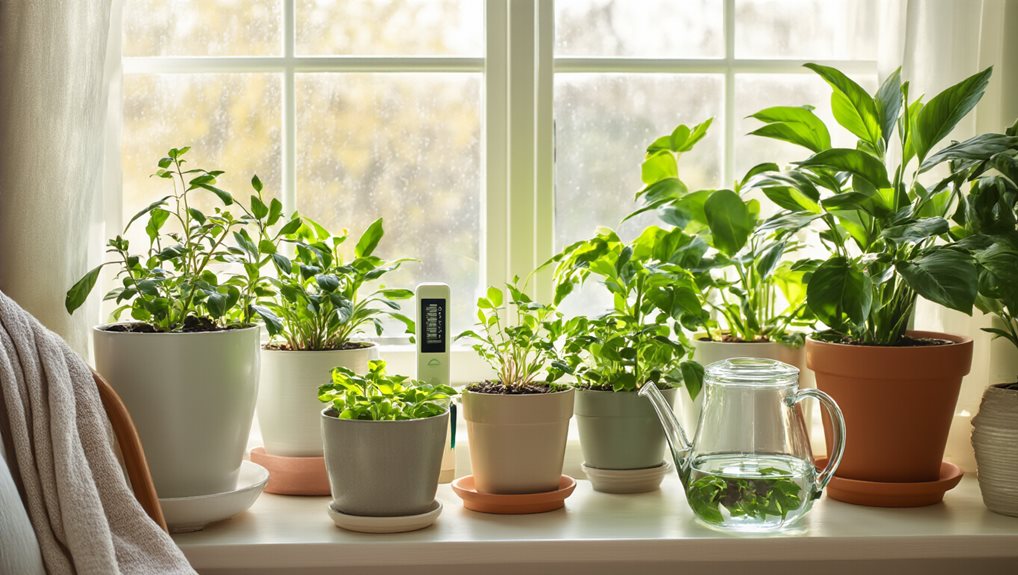
In spring, longer days and rising temperatures wake dormant buds, so you’ll water every five to seven days, gradually increasing moisture for new growth; consistent moisture supports healthy development for new leaves and roots. group plants together to create a mini humid microclimate during summer, which can reduce the need for frequent watering; summer’s heat and sunlight demand watering every few days, preferably in the morning, to replace rapid evaporation. Fall cools growth, so you ease back to weekly or less, and winter’s dormancy lets you stretch intervals to two weeks, preventing root rot.
Check Soil Moisture Before Every Watering
You can start by using the finger dip technique, inserting your finger a couple of inches into the soil to feel whether it’s dry, powdery, or slightly moist, which gives you an immediate, tactile gauge of water need.
If you prefer a more quantitative approach, weigh the pot before and after watering; a noticeable weight increase signals retained moisture, while a lighter pot indicates it’s time to water again.
For the most precise reading, employ a soil moisture meter, inserting the probe to the root zone and noting the blue, green, or red indicator to confirm the exact moisture level before each watering. The moisture level can also be influenced by the surrounding outdoor lighting conditions, which affect evaporation rates and soil drying. soil moisture
Finger Dip Technique
Ever wondered why your houseplants sometimes wilt despite regular watering? Try the finger‑dip technique: insert your index finger to the first knuckle, about one to two inches deep, near the stem. If the soil feels dry and your finger stays clean, it’s time to water; if it’s moist, hold off.
This simple test prevents overwatering, keeps roots healthy, and builds confidence in your routine.
Weight‑Based Soil Check
When you weigh a pot before each watering, you get an objective snapshot of how much moisture the soil still holds, and the method works because a dry pot consistently weighs less than a saturated one. Use a kitchen scale, record dry and saturated baselines, then compare current weight to those references; a lighter reading signals watering time, while a heavier weight confirms sufficient moisture, fostering confidence and community among fellow indoor‑plant enthusiasts.
Water Meter Readings
Regularly checking the soil moisture with a meter before each watering guarantees you’re responding to the plant’s actual needs rather than guessing. Insert the probe a third of the pot depth, centered, and wipe it clean between plants for accurate readings.
Follow the guide’s asterisks: weekly for single‑star, every 4‑5 days for double‑star, and every 3 days for triple‑star, adjusting for summer heat or dormancy.
Calculate Water Volume for Your Pot Size
How much water should you actually pour into a pot? Measure the inner diameter, then use the appropriate formula—π × (radius)² × height for cylinders, side‑length² × height for squares, or (1/3)π × radius² × height for cones—to estimate volume, and match it to the reference chart: a 5‑inch pot holds roughly 1–2 liters, a 13‑inch pot about 15–20 liters, ensuring your watering fits the pot’s capacity. Proper plant nutrition and soil moisture balance are essential for healthy roots, so consider how nutrient availability interacts with your watering plan and monitor signs of deficiency such as phosphorus-related indicators phosphorus deficiency signs to adjust as needed.
How to Use Weight or Moisture Meters for Accurate Watering
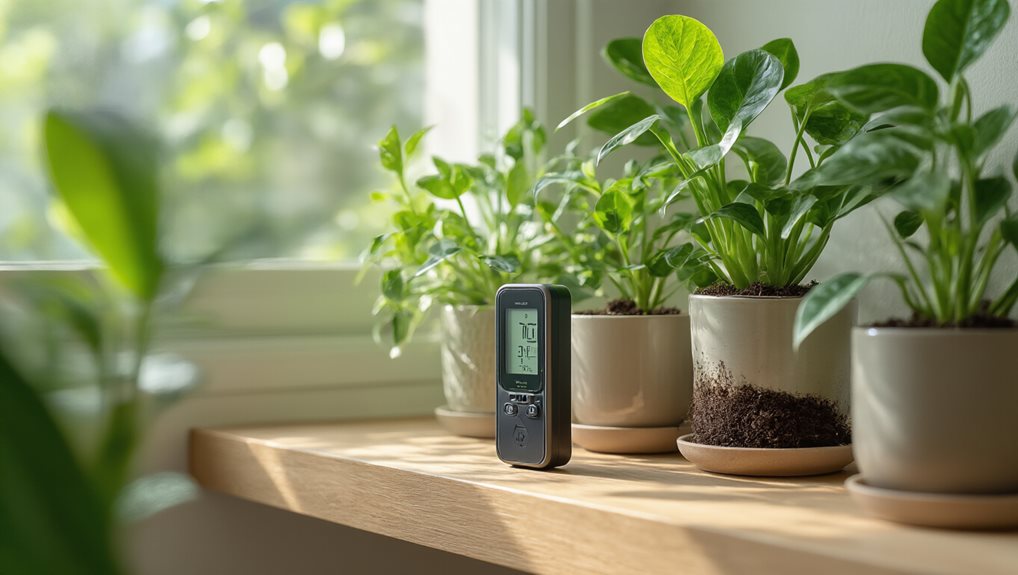
Ever wondered why your indoor plants still look wilted despite following a watering schedule? Use a moisture meter—insert it one inch below the root ball, aiming for a third of pot depth, and test multiple spots; red readings (1‑3) signal watering, green (4‑7) means okay. Weight can also guide you: lift the pot; if it feels light, water. Clean meters between plants, avoid chunky soils, and trust readings over finger checks. To reduce guesswork, consider placing a moisture-monitoring strategy near areas where chickens might be kept, as consistent soil moisture helps deter them from digging near valuable roots and garden patches monitoring strategies.
Adjust Watering for Summer and Winter
In summer you’ll need to increase watering because higher temperatures and stronger light speed up soil evaporation, so check moisture daily and water more often. In winter, cut back the frequency—most plants thrive on a bi‑weekly schedule, and overwatering can cause root rot, especially with dry indoor air from heating. Keep a moisture meter handy year‑round to fine‑tune each plant’s needs and avoid guesswork. The square foot garden approach emphasizes grid-based planning to organize crops and optimize space, which makes managing indoor plant watering more precise and efficient.
Boost Summer Watering
When summer heat intensifies, indoor plants consume water faster because higher temperatures enhance photosynthesis and accelerate soil drying, so you’ll need to adjust your watering schedule accordingly.
Increase watering frequency for tropicals to every 3–7 days, mist 2–3 times weekly, and deep‑water until drains, while succulents stay on 3–4‑week cycles.
Check soil weight, top dryness, and signs of wilting before each boost.
Cut Winter Watering
Why cut back on winter watering? You’ll notice growth slows, daylight shortens, and soil stays moist longer, so watering frequency drops dramatically—often to once weekly or even every two to three weeks.
Deep, room‑temperature water applied sparingly prevents root rot, while testing soil two inches deep ensures you’re not over‑watering.
Adjust schedules for each species, pot size, and indoor climate to keep your plant community thriving.
Monitor Soil Moisture
After cutting back winter watering, you’ll notice the soil stays moist longer, so the next step is to monitor moisture levels to fine‑tune watering schedules for both summer and winter. Use the finger test, inserting two inches deep, or a chopstick for deeper pots, and check weight for larger containers; a moisture meter gives quick, precise readings.
Summer calls for more frequent checks, winter for fewer, adjusting depth as pots grow.
Plant‑Specific Water Needs (Succulents, Ferns, Tropicals)
How often should you water your indoor succulents, ferns, and tropicals? Succulents thrive on dry intervals—water when the top two inches dry, typically every 7‑10 days in summer, extending to 14‑21 days in cooler, low‑light months; small pots need weekly drinks, larger pots bi‑weekly.
FernS demand consistently moist soil, misting daily and watering every 3‑5 days in bright indirect light, reducing to weekly in humid or low‑light settings.
Tropicals follow similar moisture‑consistent patterns, adjusting for humidity and temperature.
Detect and Correct Over‑watering Quickly
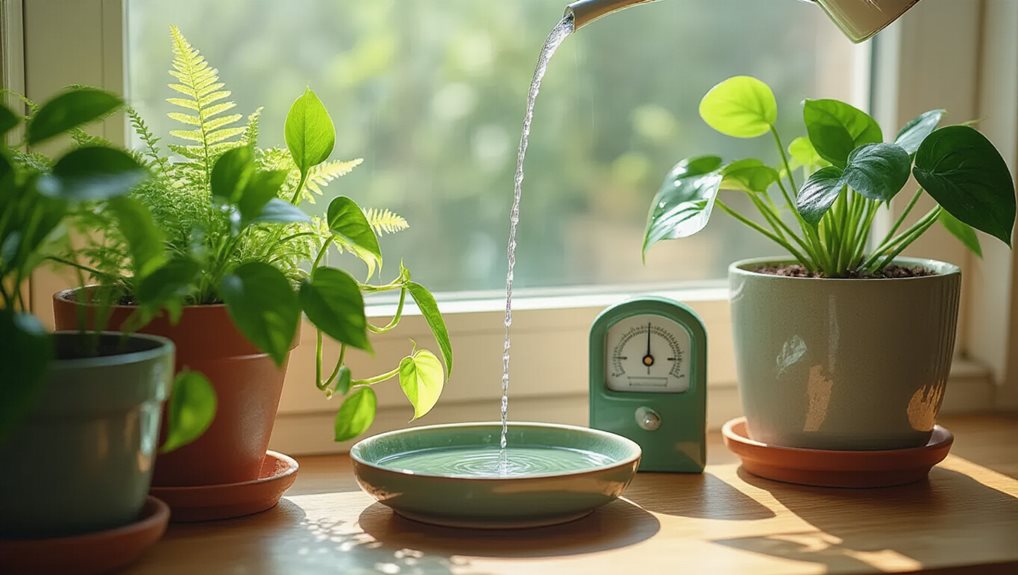
If you notice wilting, yellowing lower leaves or a soft, mushy base, you’re likely dealing with over‑watering, and catching it early can save the plant. Check soil moisture by inserting a finger or stick, then let the medium dry before the next watering; remove soggy soil, repot into fresh, well‑draining mix, and trim any mushy roots or leaves to prevent rot.
Safe Water Quality and Temperature for Healthy Roots
Detecting over‑watering is only half the battle; keeping the water you give your plants at the right temperature and quality is equally important for healthy roots.
Use lukewarm water (65‑72 °F) to avoid shock, let tap water sit 24‑hours to evaporate chlorine and stabilize pH, and favor rainwater or filtered sources over softened water, which deposits toxic salts.
This routine maintains oxygen‑rich, balanced‑temperature moisture that supports hardy root function.
Final Note
By checking soil moisture, timing watering to seasonal shifts, and matching water volume to pot size, you’ll keep indoor plants thriving. Use weight or moisture meters for precision, adjust for summer heat and winter dormancy, and respect each species’ needs—succulents demand less, ferns more. Spot over‑watering early, correct it promptly, and provide water at room temperature and with low mineral content. Consistent, informed care ensures healthy roots and vibrant growth.

Nathan McPhail is a garden and home DIY expert who writes practical, easy-to-follow advice for homeowners and gardeners. Through Yardique, he shares hands-on tips covering gardening, lawn care, landscaping, home improvement, repairs, tools, and outdoor living. His focus is on helping readers solve everyday household and yard problems with straightforward guidance, useful techniques, and practical solutions.