Fine fescues—especially creeping red and chewings—are the top choice for shady lawns because they tolerate low light, develop deep, efficient root systems, and need less nitrogen than Kentucky bluegrass or tall fescue. Their fine texture stays green under trees, they reduce mowing frequency, and they outcompete moss and crabgrass. Mix a modest amount of shade‑tolerant Kentucky bluegrass or tall fescue for added resilience, adjust seed rates for soil compaction, and follow proper soil prep, watering, and fertilizing practices to ensure establishment. Continue for detailed seed‑rate tables, soil‑type adjustments, and maintenance tips.
TLDR
- Fine fescues (creeping, chewings, strong creeping red) thrive in deep shade, requiring less nitrogen and mowing than Kentucky bluegrass.
- Tall fescue tolerates up to 70% shade, establishes quickly, and needs modest mowing, making it a reliable backup in shade blends.
- Mix shade‑tolerant Kentucky bluegrass varieties (e.g., SPF‑30 Hybrid, Total Eclipse) with fine fescues for a dense, disease‑resistant lawn.
- Seed at 3–5 lb per 1,000 sq ft for fine fescues, 5 lb for tall fescue, and 1.5 lb for Kentucky bluegrass; add 20% safety margin.
- Prepare soil by loosening the top 6 in., testing pH, adding compost, and water early morning with ½–¾ in. per session.
- For truly deep shade (under 4 hours of direct sun), skip bluegrass entirely — plant a fine-fescue blend or St. Augustine (warm climates), which are the only real options that hold up long-term
Grass Types That Thrive in Deep Shade

Rough Bluegrass thrives in damp, shaded spots, spreading by stolons and staying light‑green even at higher elevations. Indirect sun tolerance helps explain why St. Augustine endures 4‑8 hours indirect sun, especially varieties like Sapphire.
Fine Fescues vs. Other Cool‑Season Grasses in Low Light
You’ll notice that fine fescues outshine other cool‑season grasses in low‑light sites, thanks to their superior shade tolerance and efficient root systems that capture moisture and nutrients with minimal fertilizer—typically no more than 2 lb of nitrogen per 1,000 sq ft annually. In contrast, tall fescue and Kentucky bluegrass demand at least 4 hours of direct sun and higher nitrogen inputs to stay healthy, which can increase maintenance effort. Choosing fine fescues therefore reduces mowing frequency, limits crabgrass intrusion, and offers a low‑maintenance solution for shady lawns. Root systems support deeper moisture capture and nutrient efficiency, contributing to the overall resilience of fine fescues in low‑light environments.
Shade Tolerance Comparison
How do fine fescues hold up against other cool‑season grasses when light is scarce? You’ll find Chewings and strong creeping red fescues consistently top shade trials, maintaining dark green, fine texture where Kentucky bluegrass and perennial ryegrass thin dramatically.
Hard fescues produce more tillers in sun but falter in shade, while tall fescue offers coarser but respectable tolerance. Fine fescues therefore give you the most reliable, lush cover under trees.
Root System Efficiency
Fine fescues outshine most cool‑season grasses in low‑light environments thanks to their efficient root systems, which penetrate deeper and spread more uniformly through compacted, shaded soils, allowing them to tap moisture reserves that Kentucky bluegrass and perennial ryegrass simply can’t reach.
Their deeper roots access lower‑soil water, reducing irrigation needs, while Chewings and strong‑creeping red cultivars maintain vigor, letting you feel confident your shade lawn will thrive together.
Maintenance and Fertilizer Needs
Where you’re wondering whether fine fescues truly ease the upkeep of a shady lawn, the answer lies in their modest nutrient and water demands compared with other cool‑season grasses. They need less nitrogen than Kentucky bluegrass, minimal phosphorus for establishment, and infrequent mowing due to slow shade growth. Their drought tolerance reduces irrigation, while lower fertilizer use limits disease risk, letting you maintain a cohesive, low‑maintenance lawn.
Tall Fescue as Backup When Fine Fescues Aren’t Available
Ever wondered why tall fescue often becomes the go‑to substitute when fine fescues aren’t on hand? You’ll appreciate its ability to tolerate 70 % shade, survive with as little as 10 mol m⁻² d⁻¹ DLI, and thrive in partial sun, while its deep root system offers heat, drought, and cold resilience.
It establishes quickly, requires modest mowing, and adapts to varied soils, making it a reliable backup for shady lawns.
Shade‑Tolerant Kentucky Bluegrass Varieties to Mix In

The shade‑tolerant Kentucky bluegrass varieties you mix in can dramatically improve a lawn’s density and color where sunlight is scarce, and selecting the right cultivars—such as the SPF‑30 Hybrid, Total Eclipse Blend, or the Merit family—ensures you get a resilient, dark‑green carpet that thrives under low‑light conditions. SPF‑30’s rhizomatous growth fills gaps, Total Eclipse offers deep blue‑green hue, while Merit, Midnight, Nugget, and Blue Note provide compact texture, disease resistance, and consistent shade performance. When applying these blends, ensure proper preparation and moisture management to maximize establishment and longevity OSB primer and paint guidelines for protecting the soil and seedbed from moisture fluctuations and ensuring a stable, durable base for growth.
Warm‑Season Choices: St. Augustine vs. Zoysi for Shade
St. Augustine generally outshines Zoysi in shade, thriving with just 4‑5 hours of filtered sunlight while Zoysi needs closer to 6 hours to stay dense. The trade‑off is that St. Augustine grows faster and establishes quicker, but it demands more water and is prone to disease in low‑light conditions, whereas Zoysi, though slower, tolerates drought better once settled. Considering both shade tolerance and maintenance, you’ll likely choose St. Augustine for heavily shaded lawns and Zoysi for lighter shade where lower upkeep is a priority. Slow‑Release Fertilizers can help feed these grasses gradually over time, supporting steady growth and reducing the need for frequent applications.
Shade Tolerance Comparison
Where does shade tolerance matter most when choosing a warm‑season turf for a partially sunlit lawn?
St. Augustine outshines Zoysia in shaded spots, thriving with 40% shade and needing only 4‑6 hours of direct sun, while Zoysia prefers fuller light.
Cultivars like Palmetto handle tree‑cover well, delivering dense, carpet‑like growth that crowds weeds and maintains a lush, blue‑green appearance where other grasses would struggle.
Maintenance and Growth Rate
How often you’ll need to mow and how fast the grass spreads are key factors when choosing between St. Augustine and Zoysia for a shady lawn.
St. Augustine thrives at 3.5–4 inches, demands weekly mowing, and spreads 6–12 inches yearly, so you’ll be busy maintaining height and watering.
Zoysia prefers 1–2 inches, needs less frequent mowing, and expands only 2–6 inches per year, offering a more relaxed routine while still fitting into your community’s green standards.
Building a Three‑Grass Shade Blend

What makes a three‑grass shade blend work is balancing each species’ shade tolerance, growth habit, and maintenance needs, and the key is to combine fine fescue, tall fescue, and Kentucky bluegrass in proportions that let them complement one another. Use 30% creeping red fescue, 20% tall fescue, and 10% Kentucky bluegrass, seed 5‑7 lb per 1,000 sq ft, water lightly, and expect germination in 6‑12 days, creating a resilient, low‑maintenance lawn that feels like a shared, thriving community. root containment and proper soil preparation support healthy establishment for dense shade blends.
Adding Perennial Ryegrass to a Shade‑Tolerant Mix
Ever wondered why perennial ryegrass is a popular add‑on to shade‑tolerant blends? You’ll appreciate its fast germination and rapid seedling growth, which give instant color while fine fescues and Kentucky bluegrass catch up.
Its bunch‑type habit and deep roots enhance wear tolerance and moisture access, reducing moss and bare patches.
Rough Stalk Bluegrass for Wet, High‑Shade Shade

After noting how perennial ryegrass can quickly green a shade‑tolerant mix, many homeowners turn to rough stalk bluegrass when their lawns stay wet and heavily shaded.
This cool‑season Poa trivialis spreads via stolons, forming prostrate, light‑green patches that stay green through winter, tolerates high shade and moist soils, and greens early in spring.
It thrives at low mowing heights, but beware of summer dormancy, heat stress, and disease susceptibility.
How Much Seed Do You Need per 1,000 sq ft?
You’ll start by checking the seed‑rate guidelines, which usually recommend 4‑7 lbs per 1,000 sq ft for a new lawn and a lower amount for overseeding, then adjust that figure based on your soil type, since sandy or compacted soils may need a bit more seed for proper contact.
Next, factor in the expected germination rate; if the seed is coated or has a lower viability, increase the poundage slightly to compensate.
Finally, add a 20 % safety margin to cover waste and uneven distribution, ensuring you have enough material to achieve a dense, healthy stand.
Seed Rate Guidelines
For shade‑tolerant lawns, fine fescues need 3–5 lb, rough bluegrass 1–2 lb, and Kentucky bluegrass 2–3 lb; overseeding thin spots calls for about 6 lb.
Calculate by multiplying your total square footage by the rate, then divide by 1,000.
Adjust for Soil Type
How does the type of soil under your shade‑loving lawn affect the amount of seed you’ll need per 1,000 sq ft? If your ground is compacted or low‑draining, add 10–25 % more seed—so Tall Fescue moves toward 12 lb, Fine Fescue toward 7 lb, and Perennial Ryegrass toward 8 lb. For well‑drained, loamy soil, stick to the base rates: 8–10 lb, 4–6 lb, or 4–6 lb respectively. Adjusting ensures even coverage and stronger root development.
Account for Germination Rate
What amount of seed you need per 1,000 sq ft hinges on the expected germination rate of the varieties you choose, because lower germination means you must compensate with extra seed to achieve full coverage.
For shade‑tolerant mixes, aim for 1.5 lb of Kentucky bluegrass, 5 lb tall fescue, plus 1 lb fine fescue, or halve those rates when overseeding, ensuring enough viable seed to fill gaps and foster a united, healthy lawn.
Soil Prep for Shade‑Grass Success
Ever wonder why shade‑tolerant lawns often struggle before the soil is properly prepared? Clear debris, rake the area, then till the top six inches to break compaction and add oxygen. Scratch the surface, aerate with a fork or thatch rake, and test pH. Amend with compost or peat moss, spread seed, lightly rake it in, and press gently. This ensures good contact, moisture retention, and a welcoming foundation for your shaded lawn.
Watering & Fertilizing Schedules for Low‑Light Lawns
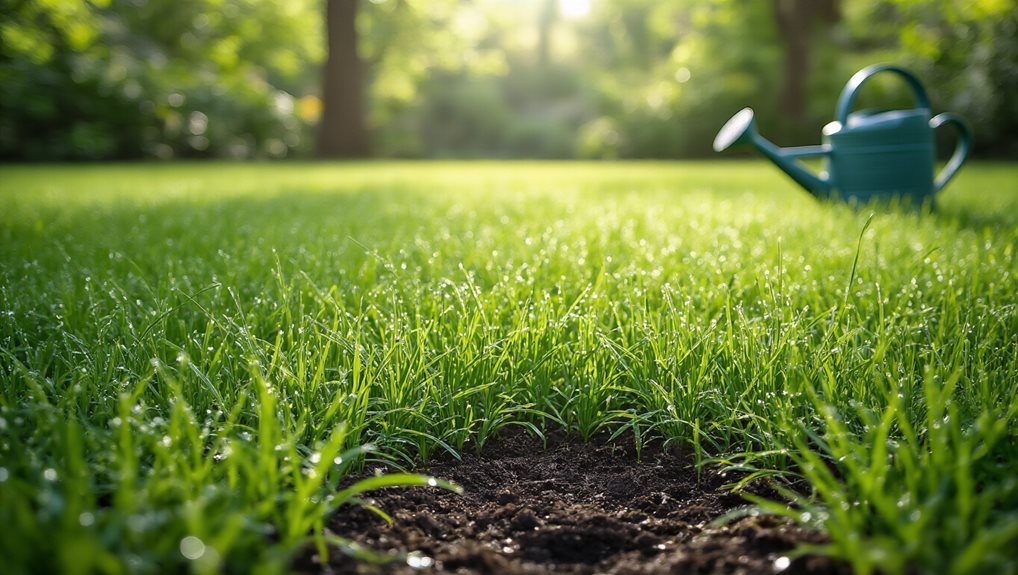
Now that your soil is loose, aerated, and pH‑balanced, the next step is to supply the right amount of water and nutrients at the right times.
Water early, 4‑10 AM, deep ½‑¾ inch per session, 1‑2 times weekly, adjusting for rain and season—summer may need three weekly.
Use drip or short sprinkler bursts to reach 6‑8 inch root zones, and apply a balanced fertilizer every 6‑8 weeks, syncing with watering to avoid leaf scorch.
Common Mistakes Planting Shade‑Tolerant Seed
Why do so many shade‑loving lawns still fail? You often pick the wrong grass, using ryegrass or bermudagrass that can’t tolerate deep shade, and you skip soil testing, leaving pH and nutrients imbalanced.
Over‑ or under‑seeding crowds seedlings or leaves gaps, while planting at the wrong time or failing to rake and tamp seed reduces soil contact.
Correct these steps, and your shade‑tolerant lawn will thrive.
Final Note
By choosing the right shade‑tolerant species, preparing the soil, and following proper seeding rates, you can establish a resilient lawn even in low‑light areas. Fine fescues generally dominate, but tall fescue, Kentucky bluegrass mixes, and warm‑season options like St. Augustine or Zoysi provide valuable backups. Consistent watering, balanced fertilization, and avoiding common planting errors will help the seed germinate quickly and fill in uniformly, delivering a healthy, attractive yard despite the shade.

Nathan McPhail is a garden and home DIY expert who writes practical, easy-to-follow advice for homeowners and gardeners. Through Yardique, he shares hands-on tips covering gardening, lawn care, landscaping, home improvement, repairs, tools, and outdoor living. His focus is on helping readers solve everyday household and yard problems with straightforward guidance, useful techniques, and practical solutions.