To estimate your yard’s drainage capacity, start by measuring its size and identifying surface types like grass, asphalt, or soil. Calculate a weighted runoff coefficient based on these surfaces, then determine rainfall intensity using local storm data and time of concentration. Use the Rational Method (Q = C × I × A) to estimate peak runoff, and size pipes or inlets accordingly. Advanced tools can refine your design for better performance and reliability. You’ll find even more practical steps to improve accuracy just ahead.
TLDR
- Measure your yard’s total drainage area in square feet or acres to determine the surface contributing runoff.
- Identify surface types (e.g., grass, concrete) and calculate a weighted average runoff coefficient based on their areas.
- Estimate time of concentration by breaking the flow path into segments and calculating travel time for each.
- Use local rainfall intensity data from IDF curves based on your area’s time of concentration for accurate peak flow estimates.
- Apply the Rational Method (Q = C × I × A) to estimate peak runoff rate and size drainage systems accordingly.
Understanding Drainage Area Size and Limits
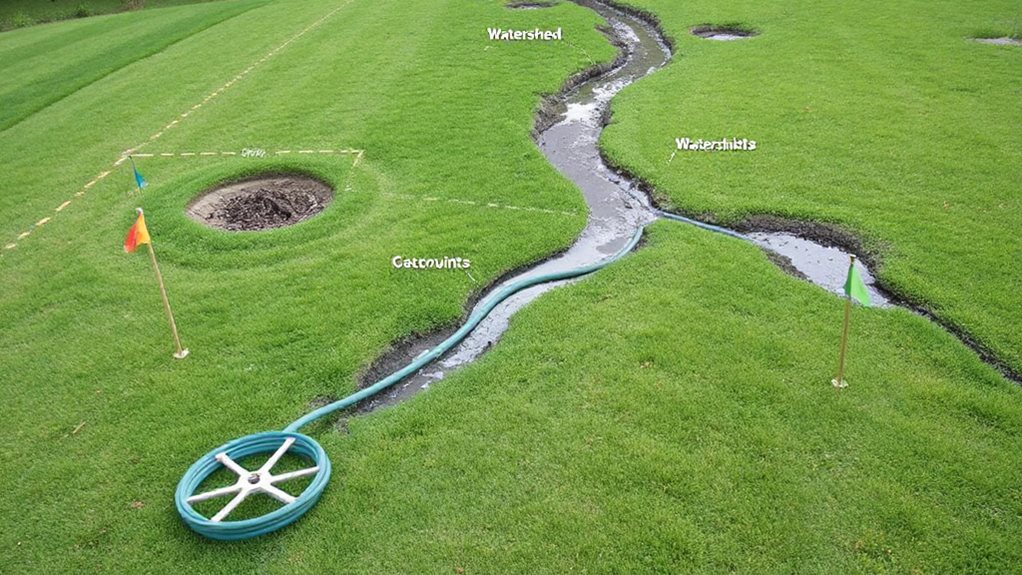
While estimating your yard’s drainage capacity, you’ll first need to determine the size of the drainage area, since accurate measurements form the foundation of any effective system.
Measure small zones in square feet or acres by multiplying length and width, or use maps and GIS for larger plots. Keep areas under 200 acres for Rational Method use, ideally under 20 for best accuracy. Consider local soil percolation and surface conditions when assessing runoff potential and designing systems like French drains or swales.
Using the Rational Method ensures proper sizing of pipes and capture devices based on peak runoff calculations.
Identifying Surface Types and Runoff Coefficients
You’ll need to identify the types of surfaces in your yard because each one affects how much water runs off during a storm.
Surfaces like asphalt, concrete, and roofs have high runoff coefficients—often between 0.85 and 1.00—meaning nearly all rain becomes runoff instead of soaking into the ground.
If you plan to add hard surfaces, consider how soil type and drainage—especially clay soils—will increase runoff and affect where water collects.
Surface Type Classification
Since the way water moves across your yard depends heavily on what covers the ground, identifying surface types is a critical first step in estimating drainage capacity.
You’ll need to classify surfaces like compacted soil, turf, gravel, or impervious pavements because each affects runoff differently.
Knowing these types helps you choose the right drainage techniques, from grading to swales, ensuring water flows efficiently without erosion or ponding.
Runoff Coefficient Selection
When estimating how much rainwater will flow off your yard during a storm, picking the right runoff coefficient is essential because it directly influences the accuracy of your drainage calculations.
You’ll consider surface types, soil, and slope, then choose a value between 0.05 and 0.95 based on how much water your land absorbs.
Use weighted averages for mixed areas, and adjust for conditions like soil moisture or connected impervious zones to guarantee reliable results.
Calculating Weighted Average Runoff Coefficient
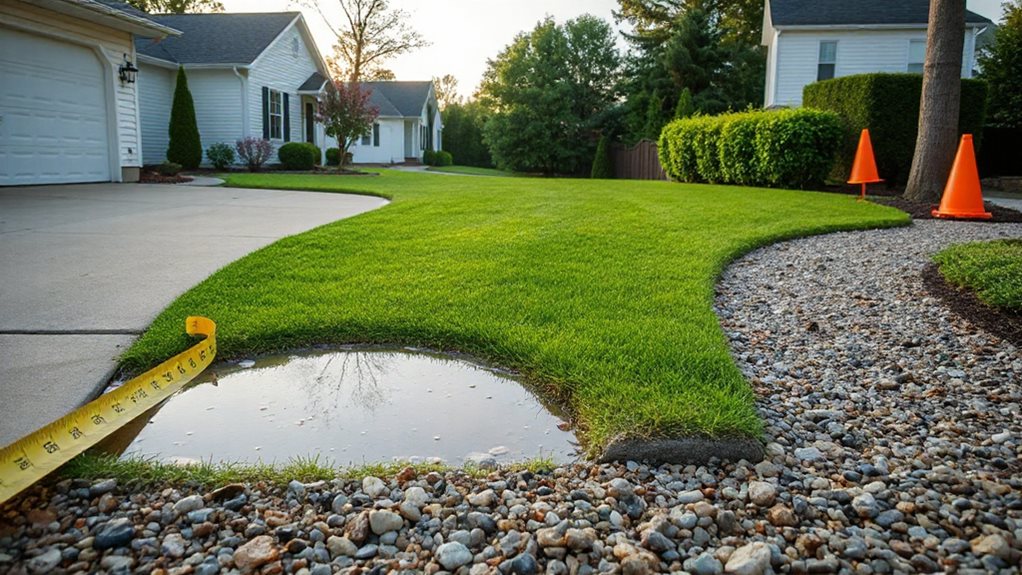
You’ll start by identifying each surface type in your yard, like lawn, driveway, or roof, and noting its corresponding runoff coefficient.
Then, calculate the area each surface covers as a portion of the total yard area, so you can apply the weighted formula accurately.
Finally, multiply each surface’s coefficient by its area fraction and sum them up to get your yard’s overall runoff coefficient for use in drainage calculations.
Consider also installing drainage solutions like a French drain to direct excess water away from pooling areas and improve overall performance.
Determine Surface Types
To get an accurate handle on how much stormwater your yard might shed during a heavy rain, start by identifying the different surface types across your property, since each material—whether it’s grass, concrete, or asphalt—responds differently to rainfall.
You’ll use standard runoff coefficients based on surface permeability, slope, and land use, pulling values from trusted tables for surfaces like roofs, pavement, lawns, or wooded areas.
Calculate Area Proportions
How do you account for a yard that’s part lawn, part driveway, and part roof when estimating stormwater runoff? Break your yard into zones, measure each area in square feet or acres, then convert to consistent units.
Calculate how much each zone contributes by finding its percentage of the total area—this guarantees accurate weighting when assigning runoff coefficients later.
Apply Weighted Formula
When dealing with a yard that mixes lawn, driveway, and roof areas, simply guessing the runoff won’t cut it—each surface sheds water differently, so you need a precise way to combine their effects.
Multiply each area’s runoff coefficient by its size, add those values, then divide by the total yard area. This weighted formula gives your yard’s overall runoff coefficient, helping you size drainage solutions accurately and confidently.
Determining Rainfall Intensity for Design Storms
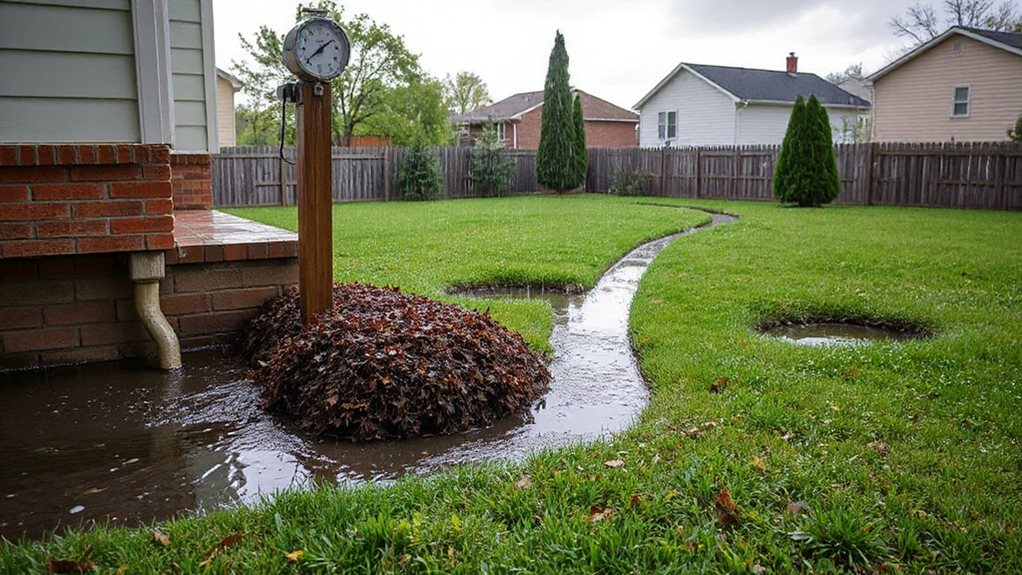
What if the storm you’re designing for isn’t just heavy, but also short and intense?
You’ll need to determine rainfall intensity using local IDF curves, based on your area’s time of concentration.
Pull data from NOAA Atlas 14 or their online server, then divide depth by duration to get intensity.
This value drives accurate, reliable drainage design.
Utility lines depths can vary, so always verify minimum burial requirements such as 3 feet for underground cables before excavating.
Applying the Rational Method Formula for Runoff
Put the rainfall intensity you determined from local IDF curves to work by applying the Rational Method formula to estimate peak runoff. Use Q = C × I × A, where your drainage area, land use, and soil shape the runoff coefficient.
Plug in values carefully—this simple yet powerful tool helps you design smarter, more effective yard drainage solutions alongside your community. Consider installing a French drain or other measures to redirect water away from problem areas.
Estimating Runoff Volume for Storage Needs
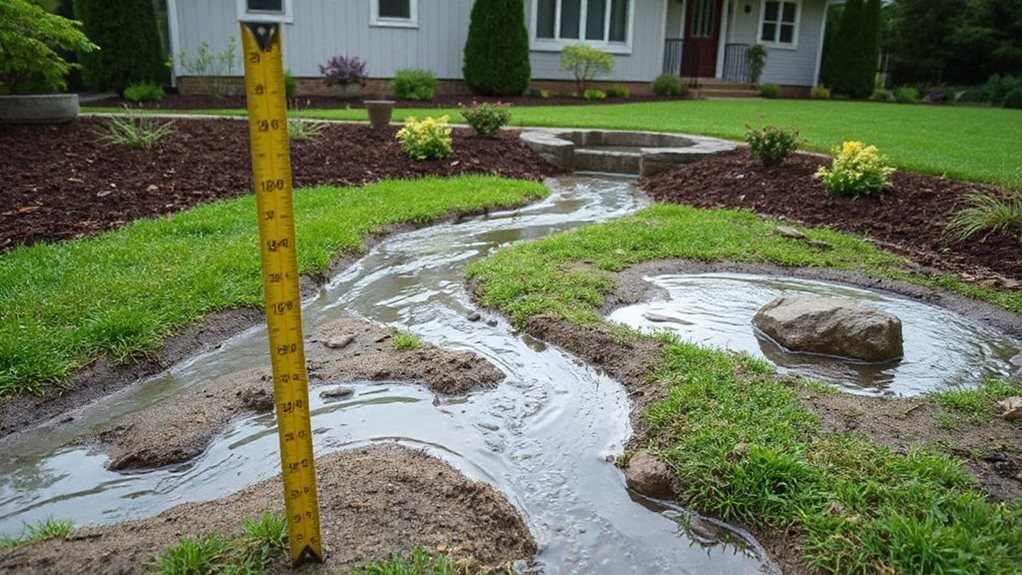
Because you’ve already calculated peak runoff using the Rational Method, you’re now ready to determine the total volume of water your drainage system must handle—this step is essential for properly sizing storage features like catch basins or detention ponds.
Multiply peak flow rate by storm duration to find total runoff volume, then convert it to acre-feet for larger areas.
Use accurate drainage area measurements and rainfall intensity data to guarantee your storage solution safely contains the expected volume.
Using Standard Storm Depths for Accurate Estimates
When designing an effective yard drainage system, you’ll want to rely on standard storm depths to guarantee your estimates reflect real-world conditions. Use NOAA Atlas 14 data from the PennDOT Drainage Manual to find 24-hour depths, like 3.40 inches for a 2-year storm.
Match these depths with Rational Method calculations, ensuring accurate runoff predictions based on your yard’s size, slope, and surface types.
Sizing Drainage Pipes and Inlets Properly
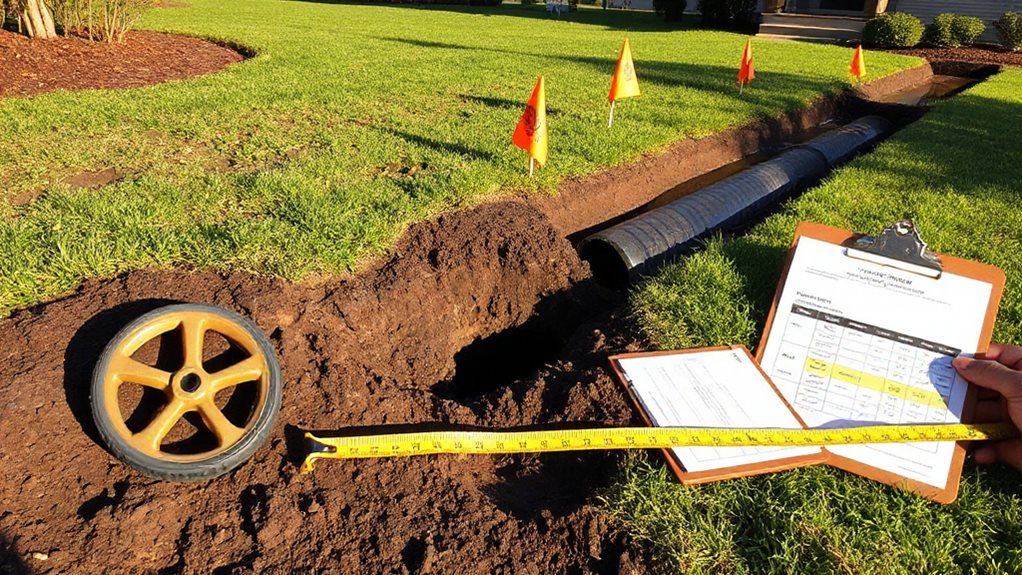
Size your drainage pipes and inlets with precision to guarantee your system handles peak flows without backing up or wasting materials. Use Drainage Fixture Units (DFUs) to tally fixture load, then match total DFUs to code tables for proper pipe diameter.
Factor in slope—1.40% for 1.5-inch pipes down to 0.40% for 4-inch—and apply Manning’s Equation to verify flow capacity, ensuring efficient, reliable drainage performance.
Evaluating Time of Concentration in Yard Drainage
You’ll start by defining the flow path from the farthest point of runoff to your drainage outlet, tracing how water moves across your yard.
Assess the surface type along this path—like grass, pavement, or shallow channels—since each affects flow speed and must be timed separately.
Then, calculate travel time for each segment using methods like NRCS or Kirpich, adding them up to get the total time of concentration for accurate drainage design.
Define Flow Path
Though determining the flow path might seem straightforward, it’s actually a critical step in accurately estimating the time of concentration for yard drainage.
You’ll need to identify the longest hydraulic path—from the farthest point of runoff to the outlet—following natural flow along surfaces, gutters, or channels, not just the longest distance.
Break it into sheet, shallow concentrated, and channel flow segments to guarantee precision.
Assess Surface Type
Because surface type directly influences how quickly water moves across your yard, accurately classifying each segment of the flow path is essential for estimating time of concentration.
You’ll assess areas like lawns, driveways, or ditches, noting how surface roughness and slope affect flow.
Each type—sheet, shallow concentrated, or channel flow—requires separate time calculations, then summed for total concentration time.
Calculate Travel Time
When estimating how quickly water travels across your yard during a storm, calculating travel time—known as the time of concentration—is a critical step in understanding drainage behavior.
You’ll assess slope, surface type, and flow path length, using methods like Kerby-Kirpich or velocity segmentation.
Exploring Tools for Advanced Stormwater Analysis
Investigate advanced stormwater analysis with powerful tools that go beyond basic drainage design, equipping you to model complex hydrologic and hydraulic behaviors accurately.
You can use StormWise for 1D/2D modeling, OpenFlows Storm for integrated simulations, GeoSTORM for AI-driven basin analysis, or Stormwater Studio for automated sewer design—each streamlines workflows while ensuring precision and compliance.
Final Note
You now have the tools to estimate your yard’s drainage capacity effectively. By evaluating surface types, using runoff coefficients, and applying the Rational Method, you can calculate expected flow from storm events. Properly sizing pipes and inlets guarantees long-term performance. Always consider time of concentration and local rainfall intensity for accuracy. With these steps, you’ll make informed decisions that protect your property from water damage while maintaining efficient, reliable drainage.